
Abstract
Hydrogen sulfide (H2S) is one of the most common treatment challenges in Florida groundwater, and ozone removes it quickly and completely. This white paper follows the City of Sanford’s Auxiliary Water Treatment Plant 2 from a 2011 ozone/GAC pilot study through full-scale operation. In the pilot, ozone reduced raw-water sulfide of 1.45–1.88 mg/L to 0.01 mg/L or less on all ten sampling days and cut UV254 absorbance by an average of 52–63%. The pilot set a design dose of 7–8 mg/L, which later sulfide-spiked testing supported. At full scale, the plant’s main challenge became bromate, not sulfide. The project shows that sulfide removal and bromate control must be designed together, and it offers practical guidance for utilities and engineers planning ozone on sulfide-bearing, bromide-containing groundwater.
Introduction
Many Florida utilities draw from aquifers that deliver dissolved H2S along with natural organic matter. The sulfide causes rotten-egg odor, corrosion, and a large oxidant demand. The organics react with chlorine to form trihalomethanes and haloacetic acids, both regulated disinfection by-products (DBPs).
Ozone addresses both. It oxidizes sulfide in seconds, adds no residual chemical to the water, and breaks organic matter into smaller, more biodegradable fragments that biologically active carbon (BAC) can then remove. Ozone followed by granular activated carbon (GAC) is therefore a natural treatment train for these sources.
The trade-off is bromate. When bromide is present, ozone can oxidize it to bromate, which has a 10 µg/L maximum contaminant level (MCL) under the Safe Drinking Water Act. This paper uses the Sanford project to show how ozone performs on sulfide-bearing water and what it takes to carry pilot success into full-scale compliance.
Technical Objectives
The Sanford pilot and the follow-up work addressed these objectives:
- Confirm that ozone reliably removes H2S from the plant’s well supply.
- Measure the reduction in organic content (UV254) ahead of GAC treatment.
- Establish a design ozone dose and contact time for full-scale equipment sizing.
- Protect the downstream GAC from residual ozone so a biofilm could develop.
- Identify the conditions that drive bromate formation at full scale and how to control them.
Source Water and Treatment Challenges
Sanford’s Auxiliary WTP 2 treats a blend of groundwater wells with characteristics common to Central Florida aquifers:
- Total sulfide of 1.4–1.9 mg/L
- Bromide of 130–235 µg/L
- Dissolved organic carbon below 2 mg/L
- pH near 7.4–7.5
The city’s goals were to eliminate sulfide, reduce DBP precursors ahead of chlorination, and establish biological activity in the GAC filters. CPH Engineers led preliminary design with Reiss Engineering, and Pinnacle Ozone Solutions provided ozone process support. The selected concept was ozone for H2S removal followed by GAC for organic carbon removal, with an ozone contact basin designed for 4.6 MGD.
Methodology
Pilot Configuration
The September 2011 pilot passed raw well water through ozone injection, a pipe reactor, and an equalization tank with a nominal 15-minute contact time, then through parallel GAC vessels. City staff sampled raw water, ozone effluent, tank effluent, and GAC effluent daily.
Operating Sequence
The pilot ran three one-week phases: ozone off (baseline), the generator at 40% output (an estimated 7.55 mg/L dose), and the generator at 50% output (an estimated 8.01 mg/L dose).
Analyses
Daily samples were tested for total sulfide, UV254, dissolved ozone, pH, and temperature. Selected samples were also tested for TOC and assimilable organic carbon.
Follow-Up Testing
In 2016, bench-scale ozone demand and decay tests were run on individual wells. Well 7 water was spiked back to its wellhead sulfide concentration so the tests would reflect true plant demand.
Results
Sulfide Removal
Ozone removed sulfide to zero or near zero throughout the pilot. Raw-water sulfide ranged from 1.45 to 1.88 mg/L, while ozone effluent read zero on nine of ten days and 0.01 mg/L on the tenth. The project team concluded that the 40% setting (about 7.55 mg/L) was sufficient for complete sulfide removal.
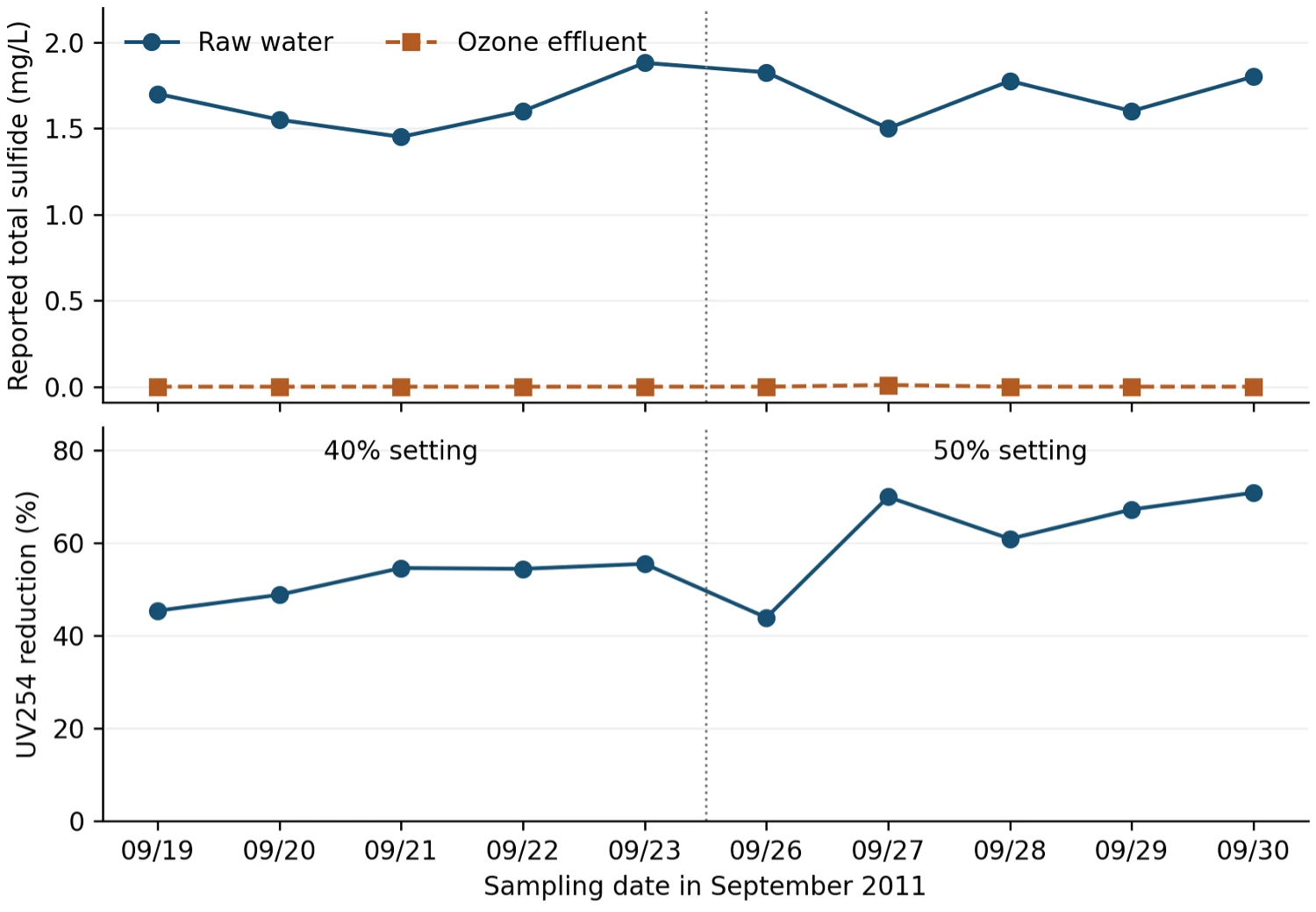
Figure 1. Daily pilot results, September 2011: total sulfide in raw water and ozone effluent (top) and UV254 reduction (bottom) at the 40% and 50% generator settings.
Organic Reduction
UV254 fell by an average of 51.7% at the 40% setting and 62.5% at the 50% setting, from raw water to ozone effluent. The fresh GAC removed most of the remaining UV254 on its own, so the full train performed well even before the biofilm matured.
Ozone Residual and GAC Protection
Dissolved ozone near the inlet of the contact basin was 0.11–0.91 mg/L, but it dropped to zero by the equalization tank on every recorded day. A Pinnacle decay curve showed residual falling below 0.5 mg/L in about 4.6 minutes, a level the GAC supplier considered safe for the carbon. Because five minutes of pipe contact at 5 MGD was impractical, the design added a contact basin.
Design Dose Validated
The pilot set a preliminary design dose of 7–8 mg/L. In 2016, sulfide-spiked Well 7 water dosed at 8.56 mg/L left a residual of 0.315 mg/L after one minute, matching plant operation and consistent with the pilot’s design basis. Sulfide was eliminated at every dose tested.
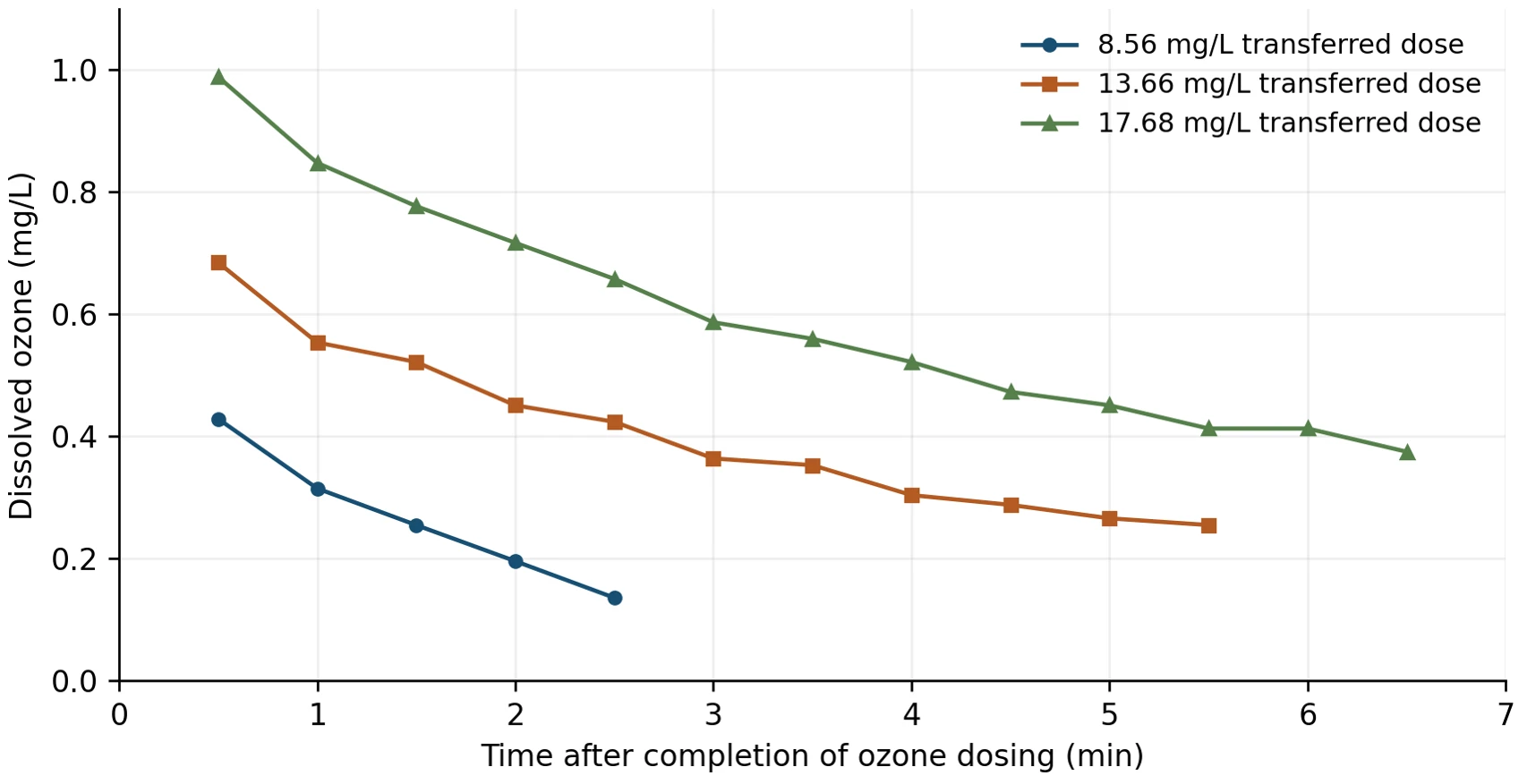
Figure 2. Dissolved ozone decay in sulfide-spiked Well 7 water at transferred doses of 8.56, 13.66, and 17.68 mg/L, June 2016.
From Pilot to Full Scale: Bromate Insights
The full-scale plant, built around a Pinnacle Zenith 30X™ ozone system commissioned in 2014, removed sulfide reliably. In December 2015, however, bromate above the 10 µg/L MCL appeared. A 2016 investigation by Guardian Manufacturing Research and Development Laboratory produced four key findings.
Bromate Formed Early
Water at the first ozone probe already held 13.2 µg/L of bromate, or 70–84% of the levels measured at GAC Filter 3. Most formation occurred in the injection and blending zone, upstream of any sample port.
Stored Samples Understated the Risk
Bench tests on stored well water produced only 0.2–3.9 µg/L of bromate. The samples had lost their sulfide in transit, so their ozone demand and chemistry no longer matched the plant. Bench tests should verify residual sulfide and spike samples back to the well’s historical H2S level.
Low Flow Increased Exposure
The contact basin was designed for 7.42 minutes at 4.6 MGD, but the plant ran at 2.2–3.2 MGD. That raised nominal contact time to 10.7–15.5 minutes and roughly halved velocity, reducing mixing in the basin.
Residual Setpoint Was Higher Than Needed
Lowering the inlet probe setpoint from 0.300 to 0.075 mg/L cut bromate from 11.8 to 7.6 µg/L, below the MCL. Any measurable residual at the probe meant sulfide was already gone, so the extra ozone added bromate without improving treatment.
Engineering Recommendations
Pilot and Bench Testing
- Verify residual sulfide when samples arrive and spike them back to the well’s historical H2S level.
- Measure bromide and bromate alongside sulfide, UV254, and residual from day one.
- Report transferred dose, not just generator percentage.
Design
- Provide sample ports immediately downstream of injection and blending.
- Size mixing and control for minimum and typical flows, not only design flow.
- Choose the dissolved ozone probe type and location for fast, accurate response.
- Include a contact basin or pipe length that lets residual decay before the GAC.
Operation and Control
- Run the lowest residual setpoint that reliably holds sulfide at non-detect (GRDL recommended 0.040–0.060 mg/L at Sanford).
- Evaluate pH adjustment to 7.2–7.3 where corrosion control allows.
- Consider ORP sensors upstream of the contact chamber for faster process control.
- Treat GAC as a bromate backstop, not the control strategy; track media age and loading.
Conclusion
The Sanford project confirms that ozone is a highly effective treatment for sulfide-bearing groundwater: it reduced sulfide to zero or near zero at every condition tested, and later testing supported the pilot’s 7–8 mg/L design basis. It also shows that sulfide removal and bromate control are one design problem. Utilities that pilot with representative water, monitor the early injection zone with well-placed, fast-responding sensors, design for real operating flows, and run the lowest effective residual can capture ozone’s full benefits while staying within bromate limits.
Sources
- City of Sanford, Pilot Field Daily logs, Weeks 1–3, September 2011.
- CPH Engineers, Meeting Memorandum, City of Sanford Aux. WTP 2 DBP Improvements, October 12, 2011.
- Guardian Manufacturing Research and Development Laboratory, Sanford, FL WTP #2 Ozone Process Optimization Report, May 2016, with June 2016 addendum.
- Pinnacle Ozone Solutions, Case Study: Sanford, FL Upgrades Water Treatment with Pinnacle Zenith 30X Ozone Generator, August 2024.
- US EPA, National Primary Drinking Water Regulations (bromate MCL 0.010 mg/L). https://www.epa.gov/ground-water-and-drinking-water/national-primary-drinking-water-regulations
