
On this page
The City of Sanford, Florida, needed to eliminate hydrogen sulfide (H2S) and reduce organic carbon in the groundwater supplying its Auxiliary Water Treatment Plant 2 (WTP 2). Rather than size a system on assumptions, the city ran a three-week ozone/GAC pilot study in 2011 with support from Pinnacle Ozone Solutions. The pilot proved ozone could drive sulfide to non-detect levels and set the design dose for full-scale equipment.
Sanford then installed a Pinnacle Zenith 30X™ ozone system, commissioned in 2014. When bromate became a concern in 2015, a detailed investigation identified the causes and the design and operating changes needed to control it. Throughout, the plant has continued to produce clear, odor-free water.
At a Glance
| Client | City of Sanford Utility Department, Florida |
| Facility | Water Treatment Plant 2, 4.6 MGD design flow |
| Source water | Groundwater with 1.4–1.9 mg/L sulfide and 130–235 µg/L bromide |
| Treatment | Ozone followed by biologically active carbon (BAC) |
| Pinnacle system | Zenith 30X™ ozone generator, 520 lb/day |
| Project partners | CPH Engineers, Reiss Engineering, Pinnacle Ozone Solutions |
Background
Sanford’s groundwater wells deliver water typical of Central Florida aquifers, and the plant’s chlorine-based treatment could not address it efficiently. The city faced:
- Rotten-egg odor from the existing aerators attempting to remove 1.4–1.9 mg/L of dissolved hydrogen sulfide
- Discoloration and organic carbon that form disinfection by-products (DBPs) when chlorinated
- Rising regulatory pressure on trihalomethanes and haloacetic acids
- Bromide in the source water, which required careful ozone design to avoid bromate
The Pilot Study
In September 2011, city staff ran an ozone/GAC pilot unit for three weeks: one week with ozone off as a baseline, then one week each at 40% and 50% generator output. Water passed through ozone injection, a pipe reactor, and a 15-minute equalization tank before reaching the GAC vessels.
- Reliable sulfide removal: raw-water sulfide of 1.45–1.88 mg/L dropped to zero on nine of ten days and 0.01 mg/L on the tenth.
- Organic reduction: UV254 absorbance fell by an average of 52% at the 40% setting and 63% at the 50% setting.
- GAC protection: residual ozone decayed to zero before reaching the carbon, protecting the biofilm the City wanted to establish.
- Design basis set: the team adopted a 7–8 mg/L design dose and added a contact basin to the full-scale design.
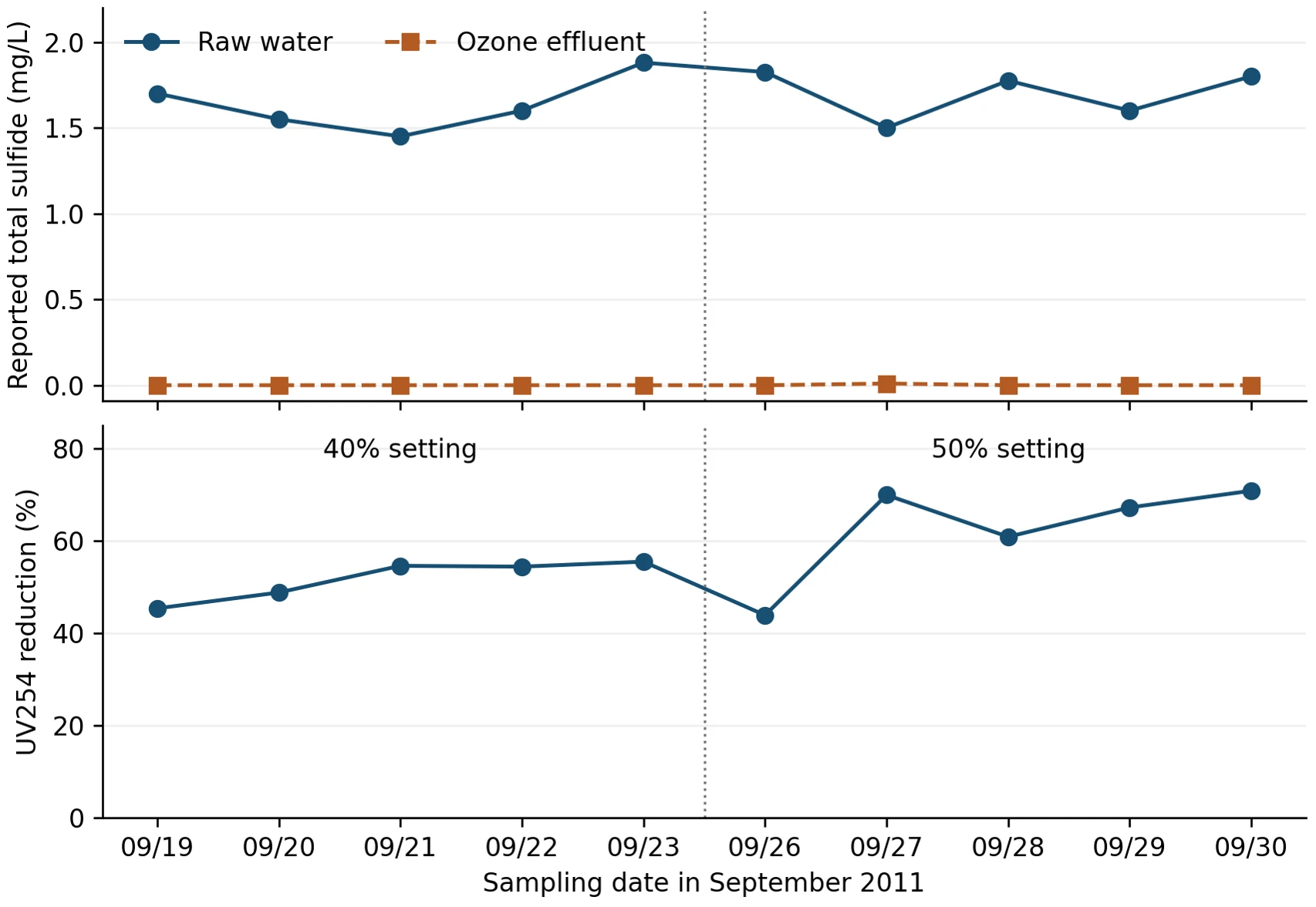
Pilot results, September 2011. Ozone held sulfide at or near zero (top) while reducing UV254 by 44–71% (bottom).
The Solution: Pinnacle Zenith 30X™ Ozone System
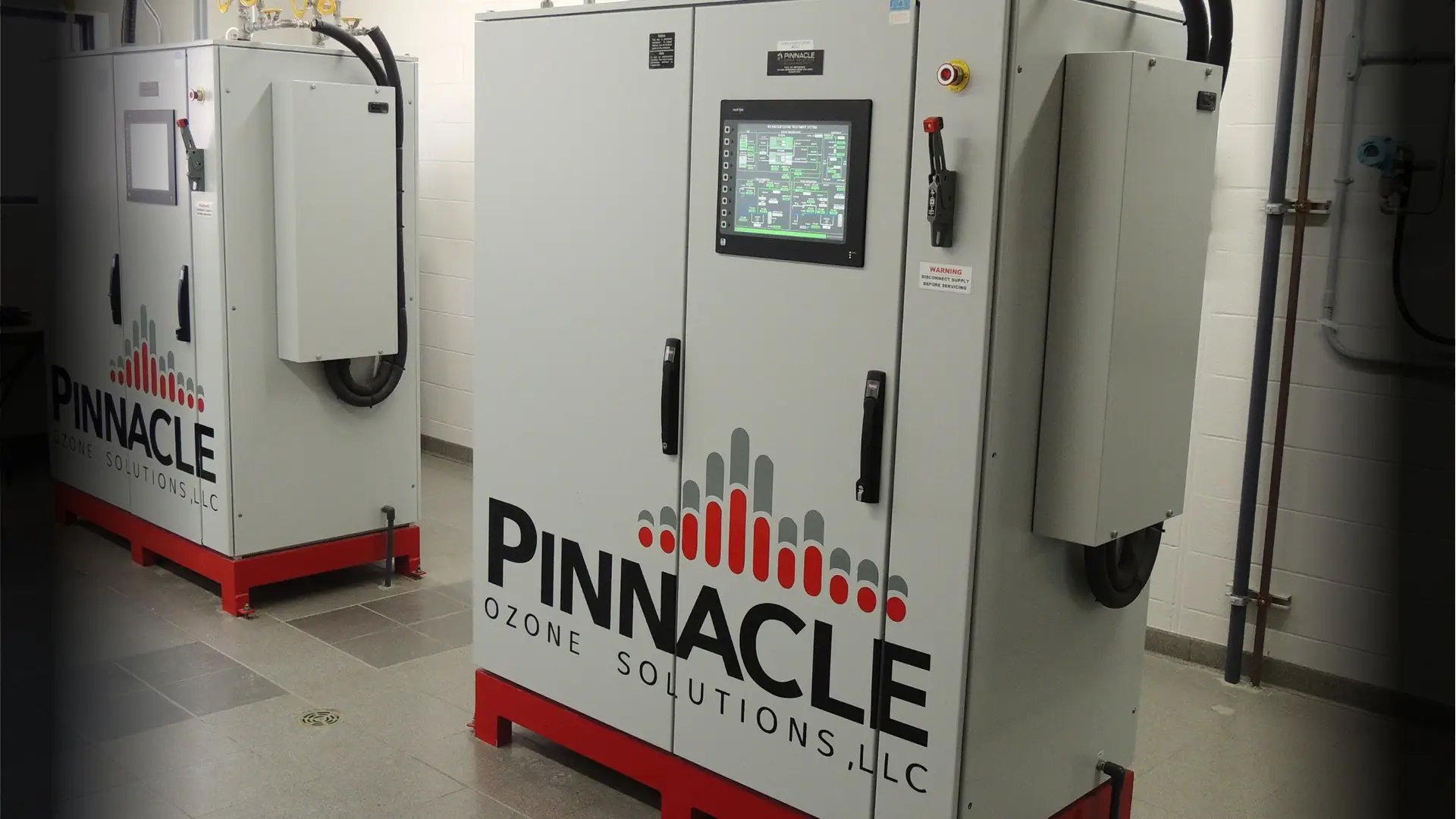
Building on the pilot results, Sanford installed a turnkey Pinnacle ozone system, commissioned in 2014:
- 520 lb/day Zenith 30X™ ozone generator with QuadBlock® Generation II cells
- 7,000-gallon liquid oxygen (LOX) storage system for a steady oxygen supply
- 30-ton chiller to hold optimal generator temperatures
- Three 890 gpm side-stream injection systems for effective ozone dissolution
- Ozone-On-Demand® controls that adjust output to real-time water quality
- Off-gas destruct system for safe ozone handling
Optimizing for Bromate Control
In December 2015, bromate above the 10 µg/L federal limit appeared in plant samples. A 2016 investigation by Guardian Manufacturing Research and Development Laboratory confirmed that sulfide removal remained fully effective and pinpointed what was driving bromate:
- Early formation: most bromate formed in the injection and blending zone, before the first ozone probe.
- Low-flow operation: the plant ran at 2.2–3.2 MGD, well below its 4.6 MGD design, which doubled contact time at the low end and reduced mixing.
- Sensor placement: the dissolved ozone probe sat downstream of where most bromate formed, limiting how quickly dose could be adjusted.
- Sensor response time: the full response time of the amperometric dissolved ozone probe needed to be considered.
- Excess residual: the residual setpoint was higher than sulfide removal required.
Lowering the ozone residual setpoint from 0.300 to 0.075 mg/L cut bromate from 11.8 to 7.6 µg/L in a single test, below the limit, with no loss of sulfide removal. Further recommendations included an inlet residual setpoint of 0.040–0.060 mg/L, pH adjustment to 7.2–7.3, relocated or additional dissolved ozone probes, added contact-basin mixing, ORP-based process control, and proactive GAC media replacement.
Results
- Clear, odor-free water: the ozone and BAC process removes H2S, color, and organic carbon.
- Clear bromate control strategy: the investigation identified residual setpoint, sensor placement, mixing, and pH as the levers for keeping bromate below 10 µg/L.
- Validated design: 2016 sulfide-spiked testing supported the 7–8 mg/L design basis established by the 2011 pilot.
- Energy efficiency: QuadBlock® technology delivers about 20% energy savings compared with traditional corona discharge systems.
- Automated operation: Ozone-On-Demand® controls keep dosing stable and reduce operator workload.
Conclusion
Sanford’s experience shows the value of piloting before building and of continuing to optimize after start-up. The 2011 pilot gave the city a proven design basis; the 2016 investigation turned a bromate challenge into a clear set of design and control lessons. Together, they make WTP 2 a model for Florida utilities treating sulfide-bearing groundwater with ozone.
To learn how Pinnacle can support pilot testing, design, and optimization for your facility, contact Pinnacle Ozone Solutions, 3001 Oxbow Circle, Cocoa, FL 32926, or visit pinnacleozone.com.
