
On this page
When engineers evaluate an ozone system, maximum ozone production usually receives the most attention. The first question is often simple: how many grams per hour or kilograms per hour can the generator produce?
Maximum capacity is important, but most water and wastewater plants do not operate at one fixed condition. Flow changes throughout the day. Source-water quality changes seasonally. Ozone demand rises and falls. Industrial production schedules change. Treatment objectives can also change with operating conditions.
That means an ozone system must do more than meet the peak design point. It must also respond accurately when the process requires less ozone.
This operating flexibility is commonly discussed as turndown. For ozone systems, however, turndown should be evaluated carefully because generator power, feed-gas flow, ozone concentration, cooling, injection, and controls all interact.
Maximum output answers one question: Can the system meet peak demand? Turndown answers another: Can the system follow the process when demand changes?
What Is Ozone Generator Turndown?
In general equipment terminology, turndown describes the range between maximum capacity and the lowest controllable operating point. A conventional turndown ratio is calculated by dividing maximum output by the minimum stable nonzero output.
Turndown ratio = Maximum controllable output / Minimum stable nonzero output
That distinction matters. A statement that a system can be controlled from 0 to 100 percent is not automatically the same as claiming a specific turndown ratio. At 0 percent, the generator is effectively commanded to zero output. A true ratio requires a defined, stable nonzero minimum operating point.
Pinnacle describes its QuadBlock technology as providing precise, linear ozone control from 0 to 100 percent. That published control range demonstrates broad modulation capability, but it should not be converted into an unsupported 10:1, 20:1, or other ratio unless a minimum stable operating point has been defined for the specific equipment and operating condition.
Why Ozone Demand Changes
Ozone demand is rarely constant. In municipal and industrial treatment systems, required ozone output can change because of:
- Water flow
- Raw-water or wastewater quality
- Natural organic matter and other ozone-reactive constituents
- Iron, manganese, sulfide, nitrite, or other reduced compounds
- Taste and odor events
- Seasonal temperature changes
- Disinfection or oxidation targets
- Plant production schedules
- Upstream treatment performance
An ozone system sized for the highest credible demand may therefore spend much of its operating life below maximum capacity. The ability to reduce output smoothly can be just as important as the ability to reach the peak design point.
A Real Pinnacle Capacity Example
Using actual published Pinnacle data makes the concept easier to understand. The Peak ozone generator is published at up to 38.4 kg/day on PSA oxygen at 10 percent ozone concentration. That equals 1.60 kg/hr. At 8 percent concentration on PSA oxygen, the published maximum is 45 kg/day, or 1.875 kg/hr.
Because Pinnacle describes QuadBlock control as linear from 0 to 100 percent, a simplified partial-load illustration at the 1.60 kg/hr rating would look like this if the operating basis remained the same:
- 100% command: nominally 1.60 kg/hr
- 75% command: nominally 1.20 kg/hr
- 50% command: nominally 0.80 kg/hr
- 25% command: nominally 0.40 kg/hr
- 0% command: zero commanded ozone output
These values are an illustration of the published linear control concept, not a declaration that every partial-load point will maintain identical ozone concentration, gas flow, energy intensity, or process performance. Actual operating conditions depend on the generator configuration, feed gas, concentration setpoint, controls, and system design.
For a Peak rated at 1.60 kg/hr under a stated condition, 50% of full-scale output is nominally 0.80 kg/hr. The example is useful only if the same rating basis is kept clear.
Ozone Concentration Changes the Capacity Basis
One of the easiest mistakes in a turndown discussion is treating ozone capacity as though it were independent of ozone concentration. It is not.
The same Peak platform is published at different maximum mass outputs depending on ozone concentration and feed-gas source. On PSA oxygen, the published maximum increases from 38.4 kg/day at 10 percent concentration to 45 kg/day at 8 percent. With gasified liquid oxygen, the published values are 45.6 kg/day at 10 percent and 54 kg/day at 8 percent.
The Summit shows the same relationship at a larger scale. On PSA oxygen, Pinnacle publishes up to 76.8 kg/day at 10 percent concentration and 90 kg/day at 8 percent, equal to approximately 3.20 and 3.75 kg/hr respectively.
Therefore, a statement such as “the generator is at 50 percent” is incomplete unless the control basis is understood. Fifty percent of what rated condition? Engineers should know the ozone concentration, feed-gas source, gas flow, and control mode associated with the output setpoint.
Turndown Is a System Question
Ozone production does not occur in isolation. A generator may be capable of broad electrical modulation, but the complete ozone system must also operate properly as output changes.
The major interacting systems include:
- Generator power supply
- Oxygen or feed-gas system
- Gas-flow control
- Ozone concentration control
- Closed-loop cooling system
- Injection equipment
- Contact system
- Off-gas destruct equipment
- PLC, HMI, analyzers, and plant SCADA
The useful operating range of the complete treatment process can be narrower than the modulation range of the ozone generator itself. Good design checks the complete system rather than stopping at the generator specification.
Generator Power and Feed-Gas Flow Work Together
Corona-discharge ozone production is influenced by the electrical energy applied to the dielectric and by the oxygen-containing gas passing through the generator. Changing generator output can therefore involve power control, gas-flow control, concentration control, or a coordinated combination of these variables.
Reducing power lowers ozone production, but feed-gas flow and ozone concentration still need to remain within the intended operating envelope. Likewise, reducing gas flow changes the mass of oxygen available and can change the relationship between ozone mass output and ozone concentration.
This is why turndown should not be reduced to a single percentage on a specification sheet. The generator, oxygen supply, flow-control hardware, analyzers, and PLC logic have to work together across the desired operating range.
Flow-Paced Ozone Control
Many ozone applications use water flow as the starting signal for capacity control. If the target applied dose remains constant, the required ozone mass changes approximately in proportion to water flow.
Ozone required (kg/hr) = Flow (gpm) x Applied dose (mg/L) x 0.0002271
For example, consider a process applying 6 mg/L ozone at 1,000 gpm. The theoretical applied ozone requirement is approximately 1.36 kg/hr. If flow falls to 500 gpm and the same applied dose is maintained, the requirement falls to approximately 0.68 kg/hr.
That example is intentionally a process calculation, not a generator rating. It shows why modulation matters: the treatment requirement can change substantially even when the target dose remains constant.
Water Quality Can Change the Dose Too
Flow is only one source of variation. The required ozone dose may also change with water quality. A plant can therefore experience two moving variables at the same time: water flow and required dose.
For example, lower plant flow does not always mean lower ozone demand if the source water simultaneously experiences higher concentrations of ozone-reactive compounds. Conversely, favorable water quality may allow the required dose to decrease even when flow remains constant.
This is why sophisticated ozone control strategies may combine flow pacing with feedback or trim signals from dissolved ozone, ORP, ozone concentration, process analyzers, or operator-defined setpoints.
Modular Staging Extends System Flexibility
Large ozone systems are often built with multiple generators or modular ozone-generation capacity. Staging provides an additional method of matching ozone production to plant demand.
A plant might operate one generator during low demand, two during normal demand, and additional generators as demand increases. Individual generator modulation can then fine-tune output between those staging points.
This creates two complementary forms of flexibility:
- Generator-level modulation to adjust output within an operating unit
- System-level staging to bring additional generator capacity online or offline
Modular staging is also closely connected to redundancy. An N+1 design, for example, must still be checked at both maximum and minimum plant conditions. The system should be able to meet peak demand with the required equipment unavailable while also avoiding unnecessary cycling or poor control at low demand.
The Injection System Must Follow the Generator
Reducing generator output may also change ozone gas flow, gas-to-liquid ratio, injector operation, diffuser performance, side-stream conditions, and off-gas volume. The mass-transfer system must therefore be evaluated across the expected operating envelope.
Engineers should confirm that reduced ozone production does not move the contacting system outside an effective operating range. Important considerations include:
- Injector vacuum or diffuser performance
- Side-stream and booster-pump flow
- Gas-to-liquid ratio
- Ozone outlet pressure and backpressure
- Mass-transfer efficiency
- Contact-tank hydraulics
- Off-gas flow and destruct capacity
A generator can have excellent electrical control while the surrounding process equipment limits useful plant turndown. The complete system should therefore be evaluated as one treatment process.
Part-Load Efficiency Matters
Full-load energy efficiency is only one operating point. If the ozone system spends most of its operating hours at partial load, engineers should also understand how auxiliary equipment behaves as ozone demand changes.
Part-load energy use can include:
- Ozone generator electrical power
- Oxygen-generation energy
- Chiller or cooling-system energy
- Injection or booster-pump energy
- Compressed-air demand
- Auxiliary equipment that may continue operating regardless of ozone output
The most meaningful efficiency evaluation therefore considers the expected operating profile, not only the maximum-output condition.
What Engineers Should Ask
When reviewing an ozone system, engineers should look beyond the maximum kilograms per hour. Important questions include:
- What is the published maximum output at the required ozone concentration and feed-gas source?
- How is output modulated: power, gas flow, concentration, or a combination?
- What does the manufacturer mean by 0-100% control?
- Is a minimum stable nonzero operating point defined for the project?
- How does ozone concentration behave at reduced output?
- Can the oxygen system and cooling system follow the same operating range?
- How are multiple generators staged?
- Can the injection system operate effectively at minimum demand?
- How is output controlled from plant flow, dose, residual, ORP, or SCADA signals?
These questions define the real operating envelope far better than a single maximum-capacity number.
The Pinnacle Engineering Perspective
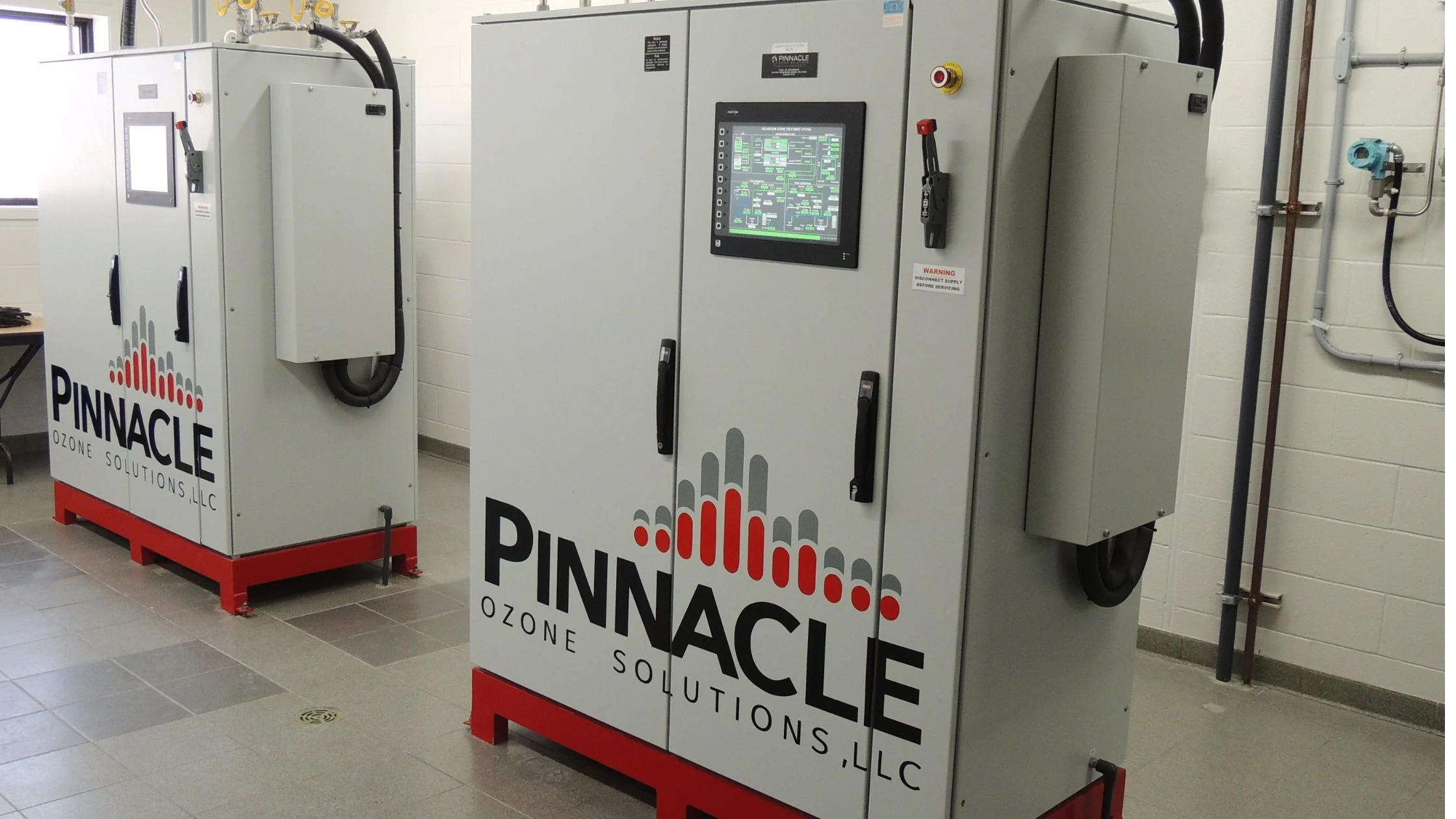
At Pinnacle Ozone Solutions, ozone system design is based on more than peak ozone production. Pinnacle’s QuadBlock technology is designed for precise, linear ozone control from 0 to 100 percent, allowing output to respond to changing process requirements.
That control capability is most valuable when it is integrated with the rest of the ozone system: feed gas, cooling, instrumentation, injection, contact, controls, safety systems, and plant automation.
For engineers and operators, the objective is not simply to own a generator with a high maximum output. The objective is to have an ozone system that can produce the amount of ozone the process actually needs, as conditions change.
Conclusion
Maximum ozone output establishes whether a system can meet peak demand. Turndown and modulation determine how well it can operate during everything below that peak.
Because real plants experience changing flow, water quality, treatment demand, and operating schedules, ozone capacity control should be evaluated across the complete operating envelope.
That means considering generator power, feed-gas flow, ozone concentration, cooling, modular staging, injection, mass transfer, process controls, and part-load energy use together.
The best ozone system is not simply the one that can produce the most ozone. It is the one that can produce the right amount of ozone, under the right conditions, when the process needs it.
Technical Source Notes
- Pinnacle Ozone Solutions, Ozone Systems. Pinnacle describes patented QuadBlock technology as providing precise, linear ozone control from 0-100 percent and identifies modulation, integration, and scalability as core system features.
- Pinnacle Ozone Solutions, Peak Technical Specifications. Published ozone output on PSA oxygen is up to 38.4 kg/day at 10% concentration and 45 kg/day at 8%; with gasified liquid oxygen, up to 45.6 kg/day at 10% and 54 kg/day at 8%.
- Pinnacle Ozone Solutions, Summit Technical Specifications. Published ozone output on PSA oxygen is up to 76.8 kg/day at 10% concentration and 90 kg/day at 8%; with gasified liquid oxygen, up to 91.2 kg/day at 10% and 108 kg/day at 8%.
- Pinnacle Ozone Solutions product technical specifications identify fixed or variable ozone-percent-by-weight control routines and automatic PID control options using ORP or dissolved ozone, supporting multiple approaches to process control.
- Partial-load mass-output values in this article are nominal illustrations based on the published linear 0-100% control statement and the stated full-scale rating. They are not presented as guaranteed minimum stable operating points or independent performance guarantees.
Prepared as a technical education article for Pinnacle Ozone Solutions. Actual ozone-system operating range, minimum stable output, concentration, feed-gas requirements, and part-load performance should be confirmed for the specific equipment configuration and project design conditions.
