
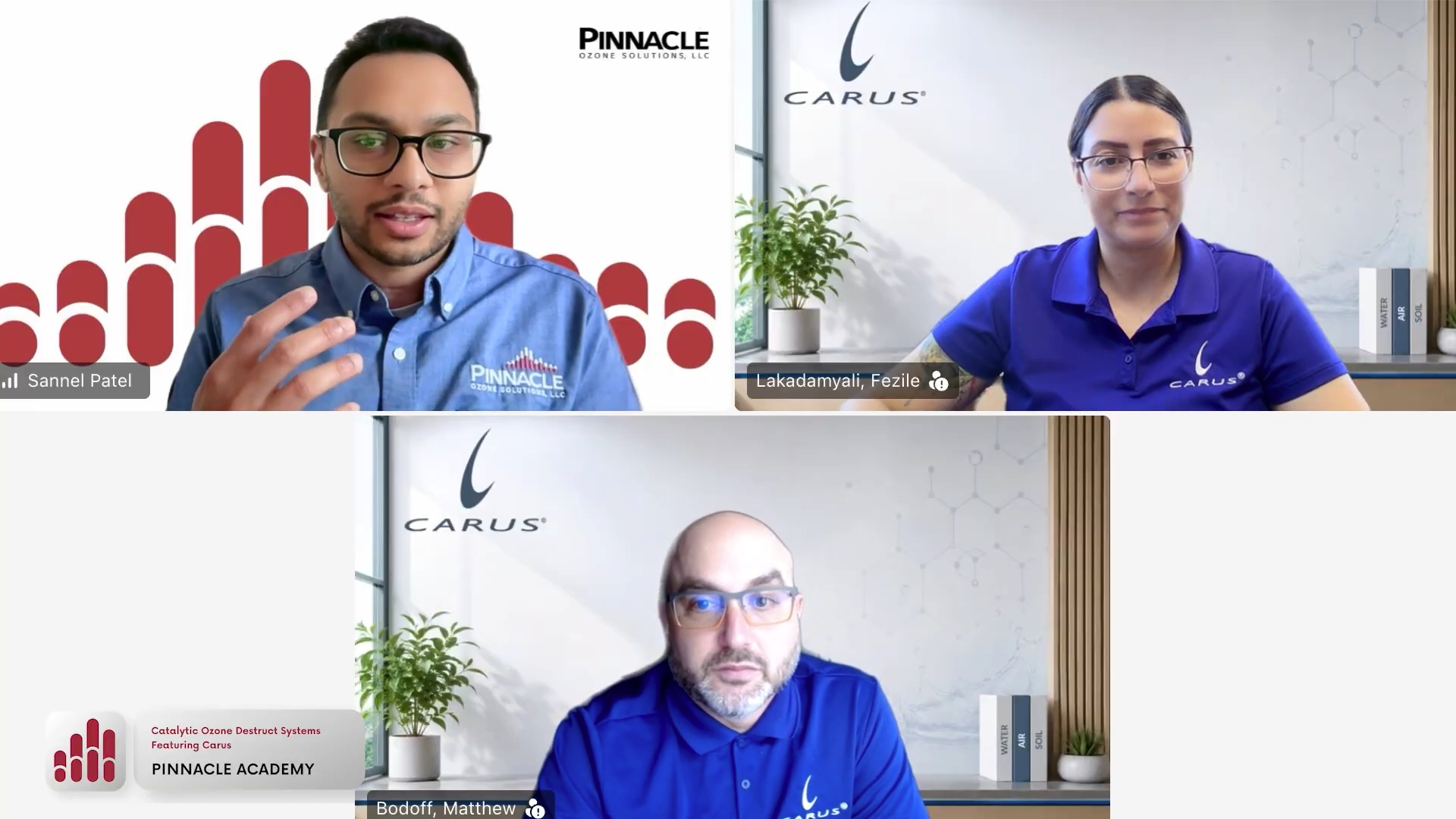
The latest episode of Pinnacle Academy tackles a critical but often overlooked piece of ozone system design: catalytic ozone destruction. Host Sannel Patel sat down with Matthew Bodoff and Fezile Lakadamyali from Carus to explain why excess ozone must be destroyed before it is ever released from an ozone system, and what it takes to do that safely and effectively.
The conversation covers the health and regulatory drivers behind destruct design, including EPA National Ambient Air Quality Standards limits of 70 parts per billion over an eight hour period, and the risks associated with improperly handled ozone, from respiratory irritation to byproducts such as bromates. Matthew and Fezile also explain how the catalyst itself does the work, with manganese dioxide and copper oxide converting ozone to oxygen at ambient temperatures without any added heat, and what separates a good catalyst from a great one, with top performing catalysts targeting 99.9 percent conversion efficiency and a long service life.
Beyond the chemistry, the episode digs into the real design and operating factors that make or break a destruct unit, including residence time, gas flow, and pressure drop. Matthew and Fezile share how to avoid moisture condensation, what commonly poisons a catalyst, such as sulfur, siloxanes, halogens, acids, and hydrocarbons, and why proper system integration matters just as much as the catalyst itself. The episode closes with a look at common myths in the industry and key advice for anyone specifying a destruct unit.
Stay tuned for more.
For more information, visit pinnacleozone.com.
Media Contact:
Hannah Smith
Media Marketing Manager, Pinnacle Ozone Solutions
Hannah.smith@pinnacleozone.com | (646) 251-7770
