
On this page
Understanding the Gap Between Equilibrium Chemistry and Operating Ozone Systems
Henry’s Law is one of the most fundamental principles used to describe gas dissolution in liquids. In ozone system design, it is often referenced to explain how ozone transfers from the gas phase into water. At equilibrium, Henry’s Law provides a clean and predictable relationship between gas pressure and dissolved concentration. However, real ozone systems rarely operate at equilibrium. Understanding the difference between theoretical solubility and actual system performance is critical for designing efficient and reliable ozone treatment systems.
What Henry’s Law Describes
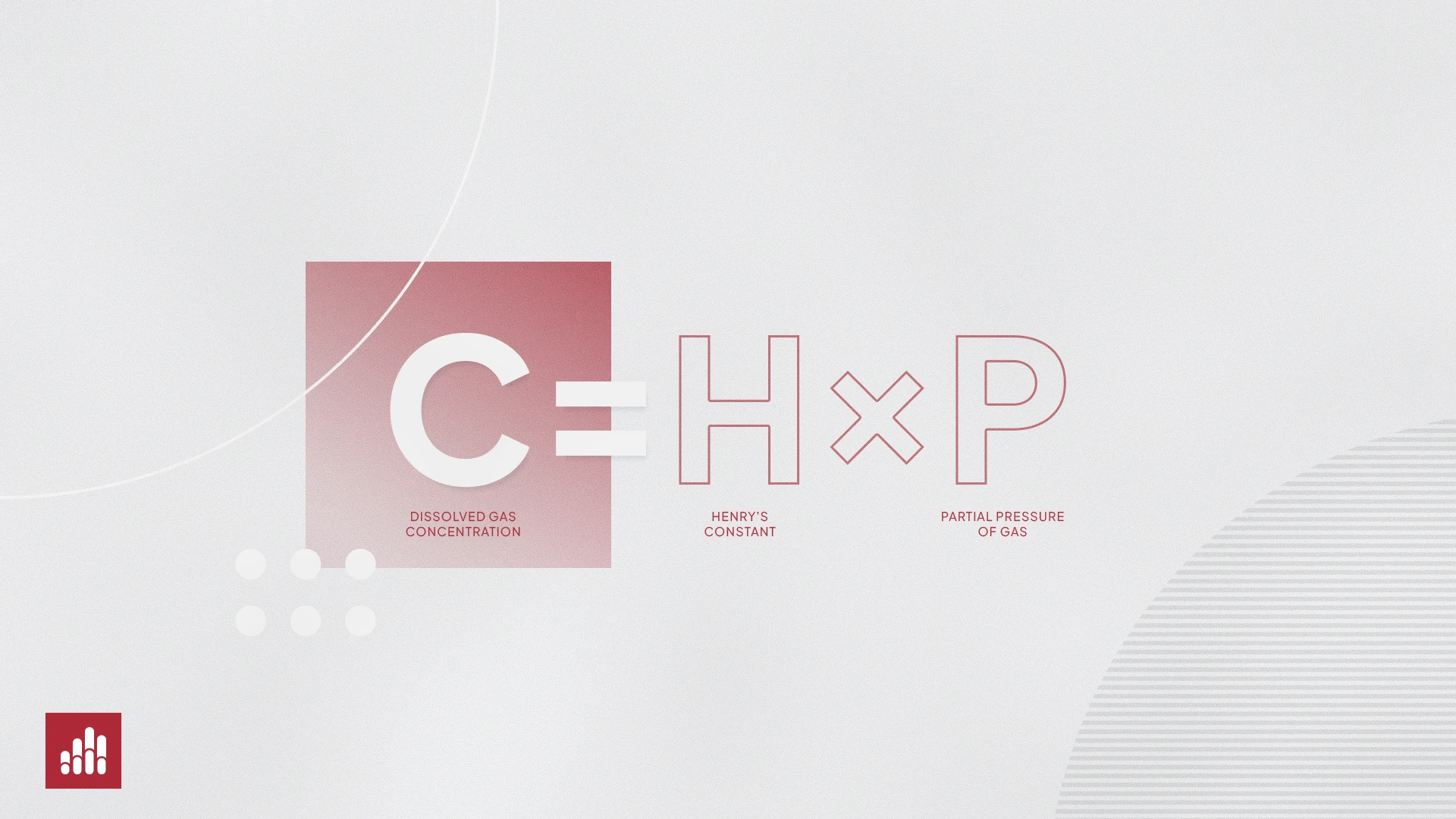
Henry’s Law states that the concentration of a gas dissolved in a liquid is proportional to its partial pressure in the gas phase. It is commonly expressed as:
C = H × P
Where:
- C is the dissolved gas concentration
- H is Henry’s constant
- P is the partial pressure of the gas
For ozone, this relationship suggests that increasing ozone partial pressure will increase the amount of ozone dissolved in water. While this is true in theory, it assumes that the system has reached equilibrium.
The Assumption of Equilibrium
Henry’s Law applies under equilibrium conditions, meaning:
- sufficient time has passed for gas and liquid phases to balance
- no reactions are consuming the dissolved gas
- temperature and pressure remain constant
In ozone systems, none of these assumptions fully hold.
Ozone systems are dynamic environments where:
- gas bubbles are continuously introduced
- water is flowing through the system
- ozone is reacting immediately upon dissolution
As a result, equilibrium is rarely achieved.
Why Real Ozone Systems Do Not Reach Equilibrium
Several factors prevent ozone systems from reaching the theoretical solubility predicted by Henry’s Law.
Immediate Reaction and Ozone Demand
Ozone begins reacting as soon as it dissolves.
It reacts with:
- natural organic matter
- reduced metals such as iron and manganese
- sulfides and other reduced compounds
- microorganisms
This rapid consumption lowers dissolved ozone concentration before equilibrium can be reached. In high-demand waters, ozone may never accumulate to its theoretical solubility limit.
Limited Contact Time
Gas-liquid contact in ozone systems occurs over seconds to minutes, not the extended durations required for equilibrium. Bubbles rise through the water column and may exit the system before full dissolution occurs. This is especially true in atmospheric contactors with limited depth.
Mass Transfer Limitations
Henry’s Law defines the maximum possible concentration, but reaching that concentration depends on mass transfer.
Limitations include:
- bubble size and distribution
- interfacial surface area
- mixing conditions
- flow dynamics
Without efficient mass transfer, the system cannot approach equilibrium conditions.
Ozone Decomposition
Ozone is inherently unstable in water. It decomposes through chain reactions influenced by:
- temperature
- pH
- alkalinity
- presence of radical initiators and scavengers
This decomposition reduces dissolved ozone concentration even in the absence of external demand.
Temperature Variability
Henry’s constant is highly temperature dependent.
As temperature increases:
- ozone solubility decreases
- decomposition rates increase
This further widens the gap between theoretical and actual dissolved ozone concentrations.
The Practical Impact on System Design
Relying solely on Henry’s Law for ozone system design can lead to significant errors.
Overestimating Dissolved Ozone
Designs based on equilibrium assumptions often predict higher dissolved ozone concentrations than can be achieved in practice.
This can result in:
- insufficient CT
- incomplete oxidation
- failure to meet treatment goals
Compensating With Oversized Generators
When systems underperform, a common response is to increase ozone production. However, if mass transfer and reaction conditions are limiting factors, increasing generator output does not proportionally increase dissolved ozone.
Instead, it leads to:
- higher off-gas losses
- reduced efficiency
- increased operating costs
Underestimating the Importance of Reactor Design
Henry’s Law does not account for reactor hydraulics.
Factors such as:
- T10 contact time
- flow distribution
- mixing conditions
have a significant impact on actual ozone performance.
Bridging Theory and Practice
To design effective ozone systems, engineers must move beyond equilibrium assumptions and consider real operating conditions.
Focus on Mass Transfer Efficiency
Designing systems to maximize gas-liquid transfer is essential for approaching theoretical solubility limits.
Account for Ozone Demand
Understanding water chemistry allows accurate estimation of how quickly ozone will be consumed after dissolution.
Design for Contact Time
Proper reactor design ensures sufficient exposure time for ozone to dissolve and react.
Integrate System Dynamics
Real systems require balancing:
- ozone generation
- dissolution
- reaction
- decomposition
This dynamic approach provides a more accurate representation of system performance than static equilibrium models.
The Engineering Perspective
Henry’s Law provides a valuable starting point for understanding ozone solubility. However, it represents an idealized condition that does not reflect the complexity of real treatment systems.
In practice, ozone performance is governed by:
- mass transfer limitations
- reaction kinetics
- hydraulic behavior
- water chemistry
Systems designed with these factors in mind achieve reliable and efficient performance.
Conclusion
Henry’s Law defines the theoretical potential of ozone dissolution, but real systems operate within practical constraints that prevent equilibrium from being reached. Understanding the difference between theory and practice is essential for designing ozone systems that perform as intended. By focusing on mass transfer, reaction dynamics, and system hydraulics, engineers can bridge this gap and deliver consistent oxidation performance.
At Pinnacle Ozone Solutions, ozone systems are engineered with a clear understanding of both theoretical principles and real-world operating conditions, ensuring that system performance aligns with process requirements rather than idealized assumptions.
